Some links in this post are affiliate links. If you buy something through one, Life in Soft Colors earns a small commission and you pay exactly the same price. (It does not change what I recommend.) More on how that works.
For a long time I thought of houseplants as the green in a room, the reliable background note that sits behind whatever color I actually cared about. Then I brought home a plant with burgundy leaves almost by accident, and it rearranged how I think about plants entirely. It was not background anymore. It was doing color work, the same way a piece of art or a throw pillow does.
The plant that started it
It was a rubber plant, the burgundy variety, not the standard green one. I did not pick it for the color on purpose, I picked it because the shop had a lot of them and the leaves looked glossy and healthy. It was only after I got it home and set it near my window that I noticed what it was doing to the room. The deep wine-red of the leaves picked up the warm undertone in my rug in a way no green plant ever had. It made the whole corner feel pulled together instead of just occupied.
That is when I started actually looking for foliage color on purpose instead of treating “green” as the only option.
Where the non-green colors show up
Once you start looking, there is more variation than you would expect just from leaves.
- Burgundy and deep red shows up in rubber plants, some varieties of ti plant, and certain begonias. It is a heavy, warm color that grounds a room the way a piece of dark wood furniture does.
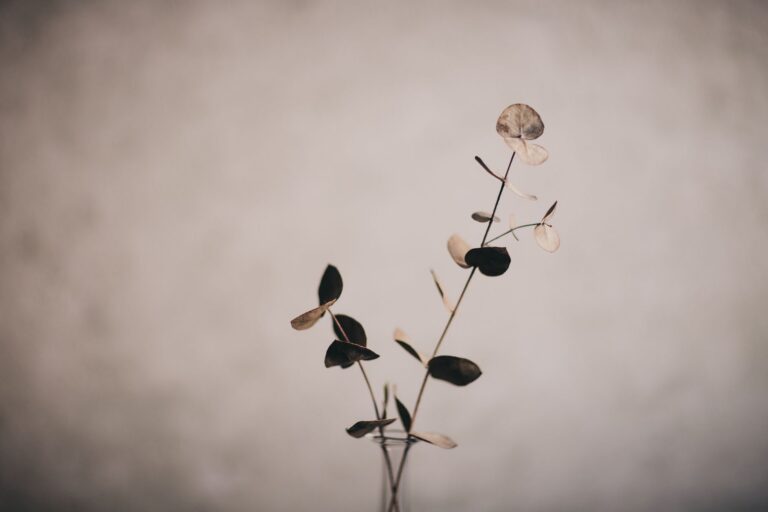
- Silvery gray-green shows up in plants like the silver pothos or certain succulents. It has that same dusty, muted quality that eucalyptus has in a cut arrangement, which makes sense since they are both doing the same trick with less pigment on the leaf surface.
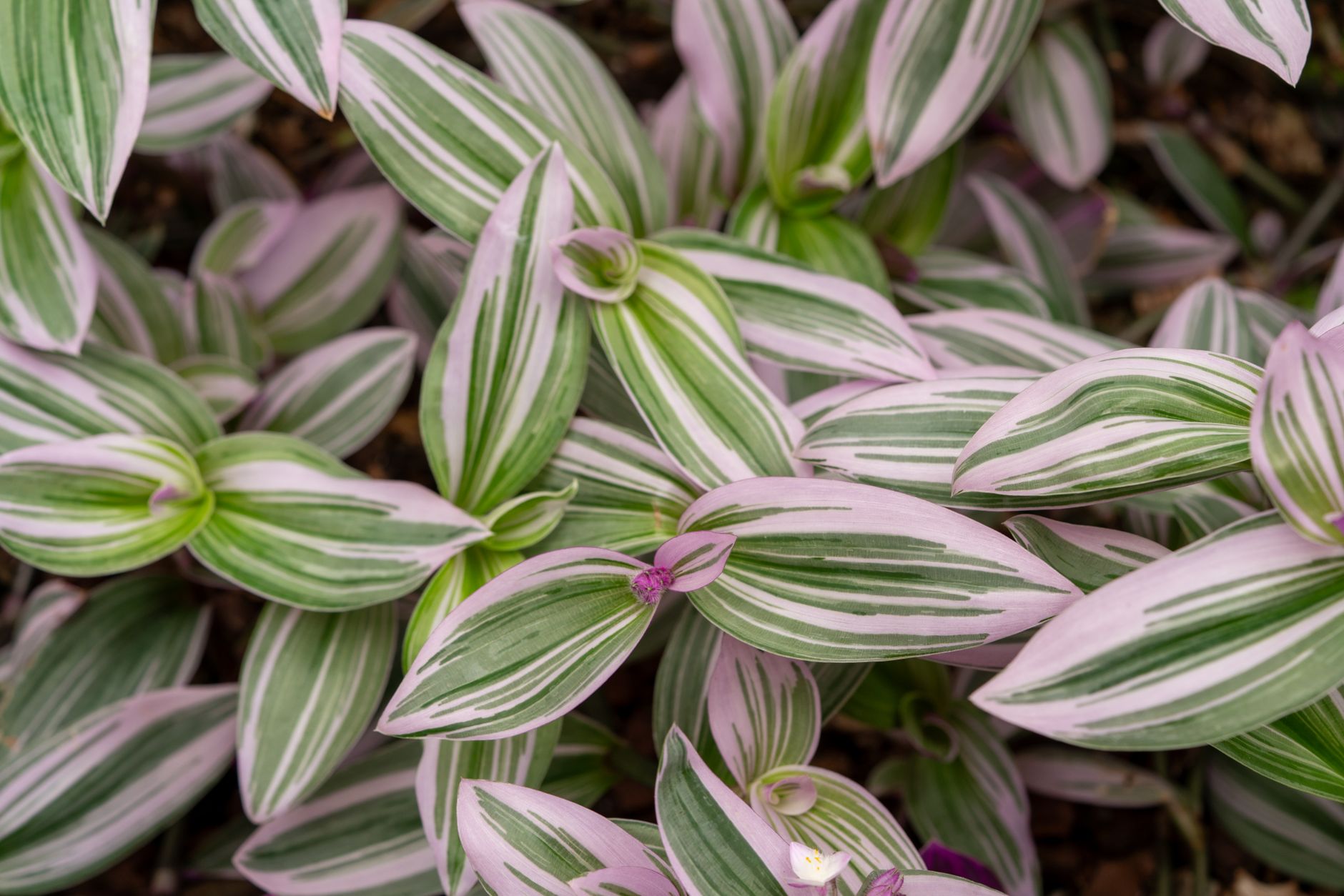
- Blush and pink shows up in variegated plants like some pink princess philodendrons or certain calathea varieties, where the color comes in streaks and patches rather than covering the whole leaf.
- Deep purple, almost black shows up in plants like the purple shamrock (oxalis) or certain tradescantia varieties. It reads almost like a shadow until the light hits it directly.
None of these are flowers. They are just leaves doing something other than being straightforwardly green, and I think that is part of why they feel so useful in a soft-colored room. A flower is temporary. A colorful leaf is just there, every day, doing its quiet color thing without needing to be replaced.
Why colored foliage reads differently than a colored flower
I have noticed that a burgundy leaf and a burgundy flower do not actually feel the same in a room, even though they are technically similar colors. The leaf feels more like a piece of furniture, something structural and permanent. The flower feels like a visitor. I think it is because leaves have that matte, slightly leathery surface that catches light differently than a soft flower petal does. The color sits more solidly. It does not shimmer or shift depending on the angle you are looking from the way a petal sometimes does.
That solidity is why I reach for colored foliage when I want a color to feel established in a room, and I reach for cut flowers when I want a color to feel temporary, like a seasonal accent I can swap out.
The light problem nobody warns you about
Here is something I learned the hard way. Colored foliage often needs more light than plain green foliage to actually hold its color. I had a pink princess philodendron that was gorgeous in the shop, streaked with pink through the green, and within about two months in my low-light bedroom, almost all the pink had reverted to plain green. The plant was not dying. It was just choosing to put its energy into green leaves instead of pink ones, because pink parts of a leaf do not photosynthesize as well, and in low light the plant seems to prioritize survival over color.
I moved it to a brighter spot near my living room window and the new growth started coming in pink again. So if you want colored foliage for the color, and not just for the novelty, you generally need to give it more light than you would give a plain green version of the same plant.
A leaf’s color is not fixed the way a painted wall is. It is a decision the plant keeps making, over and over, based on how much light it has to work with.
Putting a colored leaf next to the right neutral
The burgundy rubber plant taught me this too. Deep, saturated leaf colors need a plain background to actually read. Mine sits against a warm off-white wall, and the contrast is what makes the color visible at all. I tried moving it once to a spot near some patterned curtains and it basically disappeared into the noise. The pattern was competing with the leaf color instead of letting it stand out.
My rule now, for any colored foliage plant, is to give it the plainest background I can manage. A bare wall. A simple pot in a neutral tone like clay, cream, or matte black. Anything busy around it just cancels out the whole reason I got a colorful plant in the first place.
A short list to look for
- Burgundy rubber plant, for a heavy warm red-brown that grounds a room
- Silver pothos or silver satin pothos, for a soft gray-green that behaves like a neutral
- Purple shamrock (oxalis triangularis), for a small pop of deep purple that folds up at night, which is its own little bit of visual interest
- Calathea varieties with pink or cream striping, for a plant that behaves almost like a printed fabric
- Tricolor stromanthe, for streaks of pink, cream, and green all on one leaf
Treating leaves like part of the palette
I do not think of my plants as separate from my color plan anymore. The burgundy rubber plant is doing the same job in my living room that a dusty red pillow would do. It just happens to also need watering once a week. Once you start seeing foliage color as part of the room’s actual palette, and not just a green backdrop, it changes how you shop for plants entirely. You start asking what color this leaf is going to be sitting in your room for the next few years, not just whether it is easy to keep alive.