Some links in this post are affiliate links. If you buy something through one, Life in Soft Colors earns a small commission and you pay exactly the same price. (It does not change what I recommend.) More on how that works.
For a while I had a set of six white mugs, all the same, all bought at once because that felt like the responsible, put-together way to do a kitchen. They were fine. They were also completely forgettable, and I realized after about a year that I never once reached for one with any excitement. Then my sister gave me a single mug, a deep cobalt blue with a slightly wobbly handmade shape, and it immediately became the one I used every morning. Not because it held coffee any better. Because it was the only thing in my cabinet with any color at all.
That mug taught me something I now apply all over my apartment: you do not need everything to match, and in fact the piece that does not match is often the piece that ends up mattering most.
Why a single odd piece works in an open cabinet
If you have open shelving in your kitchen, or even just a cabinet with glass fronts, you already have a built-in display case whether you meant to or not. A row of white mugs and plates reads as calm and tidy, which is a good baseline. But a single colorful piece tucked into that row does something a full set of matching color could never do. It draws the eye without asking the whole kitchen to change its personality.
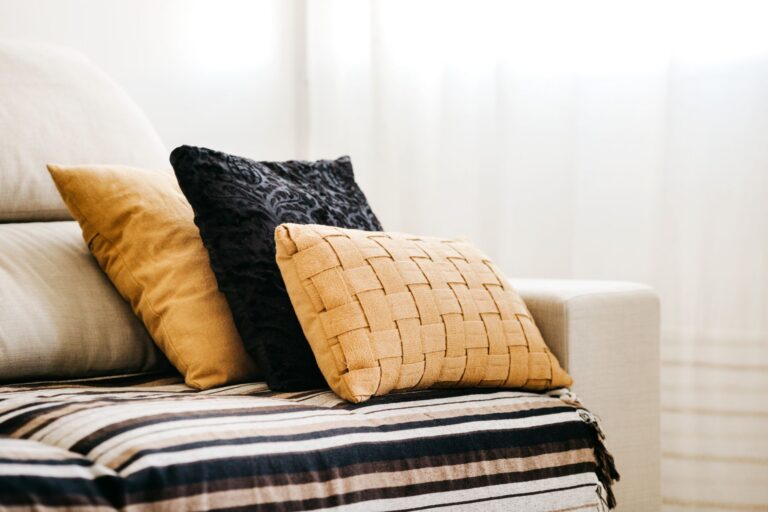
I think this works for the same reason the single pillow works on a couch. Your eye is drawn to difference. A shelf that is all one color is easy to scan and easy to ignore. The second there is one outlier, that is where your attention lands first, every time.
It does not have to be a mug
Mugs are just an easy example because most of us have a lot of them and do not think too hard about where they came from. But the same idea works with a single colored plate stacked under a set of white ones, one green drinking glass among clear ones, or a single ceramic bowl in a cabinet of otherwise plain wood ones.
- Look for pieces that already exist in your home but got shoved to the back of a cabinet because they did not match anything. Pull them forward.
- Secondhand shops are a good source for this specifically because the odd, slightly imperfect, definitely-not-part-of-a-set pieces are usually the cheapest ones there.
- One piece is the sweet spot. Two of the same odd color starts to look like a small set of its own, which changes the effect and asks more of the room.
Choosing the color for a kitchen specifically
Kitchens tend to already have a lot going on. Wood cabinets, stainless appliances, maybe a patterned backsplash. Because of that, I lean toward saturated, clear colors here rather than anything too muted or dusty, since a soft, quiet color can get lost against all that visual noise. A true cobalt, a deep forest green, a rich mustard, these tend to hold their own on a shelf in a way that a pale blush pink might not.
If your kitchen is already fairly plain, mostly white cabinets and a simple counter, you actually have more room to experiment, including with quieter colors, since there is less competing for attention.
A shelf of matching dishes is tidy. A shelf with one piece that does not match is the one people actually notice.
The everyday object advantage
What I like most about doing this with a mug rather than, say, a piece of art, is that you use it. It is not decoration sitting untouched on a shelf. It is the thing you drink coffee out of every morning, which means the color is not just something you glance at from across the room. It is something you interact with, close up, every single day.
There is something nice about that kind of color exposure. It is small, it is personal, and it does not require you to redecorate anything. You are just choosing, out of all the plain options in your cabinet, to reach for the one with some life in it.
A note on not overdoing it
It is tempting, once you notice how much one colorful mug changes your morning, to go out and buy five more colorful things for the same shelf. I would slow down here. The whole appeal of the mug that does not match is that it is the exception. If half your cabinet becomes colorful mismatched pieces, you have built a different kind of kitchen, a maximalist one, which is a fine style but a completely different goal than what we are talking about here.
If you want to add another accent piece, my advice is to put it somewhere else entirely, a different shelf, a different room, so each one still gets to be its own quiet surprise instead of blending into a growing pile of color.
Starting small on purpose
If you are nervous about color in general, the mug is honestly one of the lowest-stakes places to start. It is inexpensive, it is small, and if it turns out you hate seeing it every day, you can just put it in the back of the cabinet again. But I would bet, the way it happened for me, that you end up reaching for it more than any of the mugs that match.